How to Improve Jump Timing in Arcade Games
The fastest way to improve jump timing is to stop reacting to your character and start pressing against a fixed visual cue, then check whether your misses are consistently early or consistently late and adjust in one direction. Timing feels like a talent, but in jumping arcade games it behaves more like a measurement you can calibrate. This guide gives you a four-part method, cue, diagnose, adjust and drill, with examples from specific games.
Understand that timing is a window, not a point
Every timed jump has a window: a stretch of time in which pressing works. Early in a run the window is wide. As speed increases or targets shrink, it narrows. You do not need to hit the exact center of the window every time. You need to land inside it reliably.
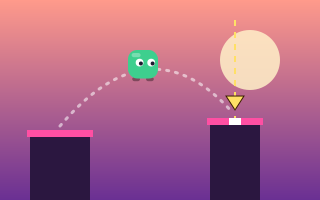
That framing changes how you practice. Instead of asking "why did I miss?", ask "which side of the window did I fall off?" In Perfect Jump, the answer is visible: if you overshoot the pillar, you pressed with too much power, and if you fall short, too little. In Bounce Up, a GOOD rating instead of GREAT tells you that you were inside the window but not centered.
Part 1: Pick a visual cue for every jump type
Reacting to your own character is slow, because by the time you see it reach an edge, the moment has passed. Better timing comes from choosing a cue that appears slightly before the moment you need to press.
Cues for incoming hazards
When hazards move toward you, pick a fixed spot on the screen and press when the hazard reaches it. In Jump Rush, hazards slide in along the ground from both sides. Choose a point a short distance from your character on each side and treat it as a trigger line. Because the hazards speed up over time, you will gradually move that line further out.
Cues for moving targets
When the target moves and you do not, watch the target's edge relative to your character. In Moving Platforms, you jump straight up to the row above. The cue is the leading edge of the platform arriving under your position. Press slightly after the edge passes, so the platform is still sliding beneath you when you arrive, which gives you a more centered landing and its bonus.
Cues for meters and bounces
For a swinging meter, the cue is a position on the meter, not the moment it reaches the top. Many players press as the meter hits the end of its swing, which is too late. Pick the point you want and press as the meter approaches it.
Part 2: Diagnose whether you press early or late
Most players have a bias. Under pressure, some rush and press early; others hesitate and press late. Finding your bias is the most useful thing you can learn about your own timing.
Run a simple audit over five runs of one game. After each failure, note whether it was early or late. Clear patterns show up quickly:
| Game | Sign of pressing early | Sign of pressing late |
|---|---|---|
| Perfect Jump | You catch the meter before it reaches your chosen point | You catch the meter after it has passed your chosen point |
| Jump Rush | You land before the hazard passes and it hits you | The hazard reaches you before you leave the ground |
| Moving Platforms | You arrive before the platform is under you | The platform slides away as you arrive |
| Bounce Up | No boost; the press came before contact | No boost; the ball had already left the pad |
For Perfect Jump, note both the meter's direction and whether you overshot or undershot. After a few runs you will see whether you tend to catch the meter too soon or too late on its swing.
Part 3: Adjust in one direction at a time
Once you know your bias, correct it deliberately and slightly. If you are late, move your cue a little earlier, meaning further from your character or earlier in the meter's swing. If you are early, move it later.
Make one adjustment per session and keep it for several runs. Changing your cue after every miss makes it impossible to tell what worked. Timing improves through consistency first and accuracy second: a player who is always a little late can fix that with one change, while a player who is randomly early or late has nothing stable to correct.
Watch out for overcorrection. If you have been late for a while and suddenly start missing early, you have moved your cue too far. Split the difference.
Part 4: Practice with short, focused drills
You can turn any game into a timing drill by giving yourself a narrow goal instead of chasing a high score.
- The ten-landing drill (Perfect Jump). Ignore your score and try to land ten PERFECTs across a few runs. You are training the center of the window, not survival.
- The GREAT-only drill (Bounce Up). Count how many GREAT ratings you can chain before getting a GOOD. Chaining boosts also climbs faster, so this drill improves your real score as a side effect.
- The no-waste drill (Jump Rush). Aim for a run with zero wasted jumps. A wasted jump resets your combo, so this drill rewards pressing only when a hazard is actually there.
- The center drill (Moving Platforms). Try to earn the centered-landing bonus on every row for as long as you can.
Keep drills short, a handful of runs each. Timing practice is most useful when you are fresh and paying attention, and less useful when you are playing on autopilot.
Keeping your timing as the game speeds up
Almost every arcade jumping game speeds up over a run. The meter in Perfect Jump accelerates, hazards in Jump Rush arrive faster, and platforms in Moving Platforms speed up and shrink. A cue that worked at the start of a run will be late by the middle.
The fix is to treat your cue as something that moves with speed. When things get faster, shift your trigger line further out or press earlier in the meter swing. Many players notice their timing "falling apart" mid-run when really their cue stayed fixed while the game changed around it.
Rhythm helps here. In games with regular patterns, count a beat between events. When the beat gets faster, count faster. Your count keeps pace with the game in a way a fixed screen position cannot.
Common timing traps to avoid
- Pressing harder when stressed. Force does not change a jump; only the moment, and sometimes the length, of the press does.
- Watching the score. Your eyes leave the cue at exactly the wrong time. Check your score after the run.
- Double-tapping out of nerves. In one-button games, an extra press can trigger an unwanted second jump or a wasted jump.
- Playing too long in one sitting. If your results drop over several runs, take a break rather than forcing more attempts.
For the reasoning behind why timing decides so many runs, read why timing matters in jumping games. For landing accuracy once your timing is steady, see our precision jumping tips, or browse one-button jump games for more timing-focused titles.
Key takeaways
- Treat timing as a window you need to land inside, not a single exact moment.
- Press against a visual cue that appears before the moment, not against your character.
- Audit a few runs to learn whether you tend to press early or late.
- Adjust your cue in one direction, slightly, and keep it for several runs.
- Use short drills like chaining GREAT bounces or zero wasted jumps.
- Move your cue earlier as the game speeds up, and use counting to keep rhythm.