Why Timing Matters in Jumping Games
Timing matters in jumping games because a jump, once started, mostly cannot be taken back. The moment you press decides where the arc begins, and in many games that single decision determines whether you land, clear the hazard or fail. As speed increases, the window for a correct press gets shorter, so timing is also what separates an early exit from a long run. Understanding the different kinds of timing a game is testing makes it much easier to see why you miss and what to change.
A jump is a commitment
Walking and steering are continuous: you can adjust them at any moment. A jump is different. Once your character leaves the ground, gravity and launch speed decide most of the path, and even games that allow mid-air steering only let you nudge it. That makes the press itself the most important input in the genre.
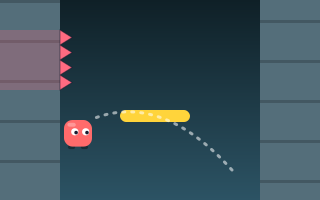
One-button games push this idea to its limit. With nothing to steer, the only question is when. In Wall Jump you cling to a wall and slowly slide down, and a single press leaps you to the opposite wall. Press a moment too early or too late and you meet a spiked section or a floating bar instead of clean wall. If you want to understand why so many arcade games are built this way, read one-button jumping games explained.
The five kinds of timing games test
"Good timing" sounds like one skill, but jumping games test several distinct ones. Knowing which one a game uses tells you how to practice.
| Kind of timing | What it asks | Where you meet it |
|---|---|---|
| Reaction | Respond to something that just appeared | Hazards entering the screen in Jump Rush |
| Anticipation | Press early so the jump meets a future position | Moving rows in Moving Platforms |
| Rhythm | Press on a repeating beat | The swinging power meter in Perfect Jump |
| Contact window | Press at the instant of touching a surface | Boosted bounces in Bounce Up |
| Duration | Hold for the right length of time | Short hops versus high jumps in Jump Over |
Reaction versus anticipation
Pure reaction is always slightly late, because the brain needs time to see, decide and press. Games at higher speeds quietly shift the demand from reaction to anticipation: you must commit to the jump before the obstacle is right in front of you. Players who keep reacting feel the game "suddenly" becoming unfair, when really the skill required has changed.
Rhythm
Repeating patterns can be timed by beat instead of by sight. Once you have a rhythm, your press arrives on time even if your attention flickers. The catch is that many games change the tempo as you progress, so the rhythm must be re-learned as you go.
Contact windows
Some games ask for a press at the exact moment of contact. In Bounce Up, the ball bounces on trampoline pads automatically, but pressing Jump just as it touches a pad gives a boosted bounce rated GOOD or GREAT. The rating is a direct readout of your timing, which makes it an unusually clear teacher.
Duration
Timing is not only about when a press starts; sometimes it is also about when it ends. In Jump Over, a tap makes a short hop and a hold makes a higher jump. Hovering drones are placed so that a full jump hits them while a short hop passes underneath, so a press that starts at the perfect moment but lasts too long still fails. Duration timing is easy to overlook because it feels like part of the press, but it is a separate skill that needs its own attention, especially on touchscreens where there is no physical key to feel.
When games combine them
Many games test more than one kind at once. Perfect Jump combines rhythm with precision, since the meter swings at a steady pace but speeds up over time. Jump Rush mixes reaction with judgment: hazards arrive from both sides at increasing speed, and you must decide whether each one needs a jump at all. Recognizing the mix helps you see which part of a miss was the real problem.
Try this: for your next few runs of any game, say out loud which kind of timing caused each miss: reaction, anticipation, rhythm, contact or duration. The pattern usually points to one skill to focus on.
Why speed shrinks your margin
Most arcade jumping games speed up as you play. Speed does not change the obstacle, but it changes how long a correct press stays correct. If there is a certain stretch of ground from which a jump clears a spike, that stretch is crossed faster at higher speed, so the time available to press shrinks.
Tiny Jumper shows this clearly. A tiny runner circles a small round planet, spikes appear on its surface and speed increases every lap. The spikes do not get harder in themselves, yet each lap feels tighter because the same jump must happen in less time. You can tap again in mid-air to double jump, which buys back some margin if the first tap was early.
When physics changes the timing
The same press can need different timing when the game's physics changes. In Gravity Jumper, one button flips gravity so you fall to the ceiling or back to the floor. Inside low-gravity zones, shaded purple, flips are slower and floatier, so you must flip earlier to arrive in time. Players who carry their normal timing into a purple zone tend to arrive late at the other surface.
The same idea applies to any game with momentum or wind. A running start in Tower Jumper makes jumps higher, and wind gusts in Sky Jump push you sideways, so the right moment to jump depends on your speed and the conditions. For the math behind these effects, see jumping game physics explained.
How games reward good timing
Because timing is so central, scoring systems often reward it directly, not just by letting you survive:
- Precision bonuses: Perfect Jump awards a PERFECT for landing in the small center target, with a combo multiplier up to x5.
- Restraint bonuses: Jump Rush raises its multiplier for each hazard cleared and resets it for a wasted jump, rewarding presses that are needed and on time.
- Faster progress: chaining boosted bounces in Bounce Up climbs faster, which matters because pads get sparser with height.
- Placement bonuses: Moving Platforms gives a bonus for centered landings.
In all of these, two players who survive equally long can finish with very different scores. The difference is timing quality. More on this in how high-score jumping games work.
Building better timing
Timing improves with deliberate practice more than with raw repetition. Choose the kind of timing you want to work on, choose a game that isolates it, and play short focused sessions. Our practical guide on how to improve jump timing gives step-by-step drills, and precision jumping tips covers landing accuracy once your timing is steady. For games where timing is the whole challenge, browse the one-button jump games category.
Key takeaways
- A jump is a commitment: the moment you press decides most of its path.
- Games test five kinds of timing: reaction, anticipation, rhythm, contact windows and duration.
- Rising speed shrinks the time available for a correct press, pushing you from reacting toward anticipating.
- Changes in physics, such as low gravity or momentum, change when you need to press.
- Scoring systems often reward timing quality directly through bonuses and multipliers.