How High-Score Jumping Games Work
High-score jumping games give you one run that keeps getting harder until a mistake ends it, and your result is a single number built from a base measure (height, distance or obstacles cleared) plus bonuses and multipliers. Beating your best is rarely about surviving longer alone; it is about understanding which actions the score rewards most. This guide takes apart the scoring systems used across our games and shows how to use that knowledge to set better personal bests.
The shape of a high-score run
Almost every high-score game follows the same arc. It starts gentle so you can find your rhythm, then ramps up speed or complexity until the challenge outpaces you. The run ends on a clear failure condition, and the score is shown against your personal best.
That structure has a useful consequence: the early part of every run is nearly free. Points earned while the game is still easy are the cheapest points you will get, so this is where to be greedy about bonuses. Later, when speed is high, safety usually matters more than extras.
The base score: what is being measured
The base score is the thing that goes up just by staying alive and making progress. On Jumping Arcade it comes in a few forms:
| Base measure | Games | What it rewards |
|---|---|---|
| Height climbed | Endless Jumper, Bounce Up, Wall Jump, Sky Jump, Lava Jump | Upward progress, often against a scrolling screen or rising hazard |
| Distance run | Jump Over, Double Jump Challenge, Gravity Jumper | Survival on an auto-running course that speeds up |
| Floors or rows | Tower Jumper, Moving Platforms | Each successful step up the structure |
| Hazards cleared | Tiny Jumper | Each spike you jump over on the circling planet |
Games built only on a base measure reward consistency. Nothing extra is on offer, so the best strategy is simply to avoid risk. Once bonuses and multipliers enter, the calculation changes.
Bonuses: points on the side
Bonuses are optional pickups or achievements layered on the base score. Stars in Sky Jump, orbs in Double Jump Challenge and coins in the air in Jump Rush are all examples. Other games reward precision instead of collection: Moving Platforms gives a bonus for centered landings, Lava Jump adds a bonus for time survived, and Spike Jumper adds checkpoint bonuses to your furthest distance.
The question to ask with any bonus is: what does it cost to get? In Double Jump Challenge, an orb that requires using your second jump early may leave you with no mid-air correction if the next platform is further than expected. The two dots showing remaining jumps tell you exactly how much safety you have left. If both are gone, the orb is probably not worth it.
Rule of thumb: collect bonuses that are on or near the path you were going to take anyway. Detours for pickups are what end most promising runs.
Multipliers and combos: where big scores come from
A multiplier scales everything that follows. That makes it far more valuable than any single bonus, and it is why two players with similar survival times can have very different scores.
Precision combos
In Perfect Jump, you jump from pillar to pillar using a swinging power meter. Landing inside the small center target counts as PERFECT and earns a bonus plus a combo multiplier that can reach x5. Since the meter speeds up and pillars narrow over time, a player who builds the combo early banks more points during the easier stretch.
Discipline combos
Jump Rush tests a different skill. Your character stays in the center while hazards slide in from both sides. Each hazard cleared raises the combo multiplier up to x5, but a wasted jump, meaning a jump when nothing was cleared, resets it. Here the multiplier rewards restraint: jumping only when a hazard is actually arriving is worth more than nervous extra hops.
Momentum combos
Tower Jumper gives a combo bonus for jumping over several floors at once. It rewards the risky, fast play style the game is built around, since the faster you run, the higher you jump.
How runs end and why it matters for scoring
The failure rule shapes strategy as much as the scoring rule does:
- One hit ends it: Jump Rush, and games where touching lava or missing a pillar ends the run. Every risk is total, so only take bonuses you are confident about.
- Falling behind ends it: in Wall Jump and Tower Jumper the screen scrolls upward, and falling off the bottom ends the run. Speed is part of survival.
- Limited lives: Spike Jumper gives 3 lives and respawns you at the last checkpoint. A single mistake is recoverable, so you can afford to learn a section.
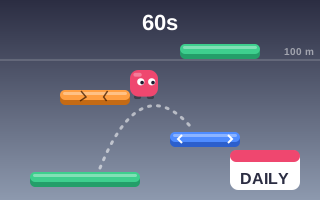
- A time limit: Daily Jump Challenge gives you 60 seconds to climb as high as possible. There is no reason to play slowly; the clock ends every run.
Daily scores versus endless scores
Most high-score games generate a fresh layout each run, so your score reflects how well you handle whatever appears. Daily Jump Challenge works differently: its vertical course is generated from the date in UTC, so everyone gets the same layout on the same day. That changes how you should approach it. In an endless game, you improve by learning general rules. In the daily course, you can also learn the specific route, and each attempt that day makes the next one better informed. Early attempts are for scouting; later ones are for execution. When the date changes, so does the course, and the learning starts again.
How your best scores are saved
Jumping Arcade has no accounts and no online leaderboards. Your personal best for each game is saved in your own browser using localStorage, a small key-value store that stays on your device and is not sent to a server. Daily Jump Challenge also keeps your best score for each date, and its Share button lets you share or copy your result if you choose to.
Two practical points follow. Your records are tied to the browser and device you play on, so switching from a laptop to a phone starts a fresh set. And clearing your browser data removes them, as does the "Clear my saved data" button on our privacy policy page.
A plan for beating your best
- Identify the multiplier. If the game has one, build it during the easy opening.
- Price every bonus. Take pickups on your path; skip detours once speed climbs.
- Know the failure rule. Play boldly with lives or a timer, carefully with one-hit runs.
- Review the death. Note what ended each run. Repeated causes point to one habit to fix; our guide to improving jump timing helps with the most common one.
Browse every game built around chasing numbers in the high score jumping games category, or read the endless jumping games guide for survival strategy in runs with no finish line.
Key takeaways
- A score is a base measure (height, distance, floors or hazards) plus bonuses and multipliers.
- Multipliers scale everything after them, so building them early is worth more than any single pickup.
- Some combos reward precision, like PERFECT landings; others reward restraint, like avoiding wasted jumps.
- The way a run ends, whether one hit, falling behind, lives or a timer, should set how much risk you take.
- Personal bests are stored locally in your browser; there are no accounts or online leaderboards.