Endless Jumping Games Guide
Endless jumping games have no finish line: you keep climbing or running until a mistake ends the run, and the game gets harder the longer you last. Doing well in them is less about any single jump and more about pacing, knowing which phase of the run you are in, what the game is about to throw at you, and how much risk each phase can afford. This guide breaks a typical endless run into phases, gives strategy for four endless games on Jumping Arcade, and covers how to push your personal best without burning out.
What makes endless games different
In a game with levels, you can learn a fixed layout and improve by memorizing it. Endless games usually generate their layout as you go, so you cannot memorize specific jumps. What you learn instead are the rules: which platform types appear, how gaps change with height, how fast the pressure builds.
That shifts the skill from memory to judgment. Every few seconds you make a small choice about which platform to aim for, whether a bonus is worth the detour, or whether to play safe. Over a long run, those choices add up to more than any single perfect jump.
It also means your score is a running record of your judgment. The height or distance you reach tells you how long you made good decisions before one went wrong.
The three phases of an endless run
Most endless jumping games share the same escalation curve, even if they look very different. Thinking in phases helps you match your play style to the moment.
Phase 1: Cruise
The opening is generous. In Endless Jumper, early platforms are close together and mostly green and stable. This is the phase to build clean habits, not to take risks. Losing a run here costs you the most, relative to how easy it was.
Phase 2: Build
New elements arrive. Blue moving platforms, orange crumbling ones and yellow spring pads start to mix in, and gaps widen. This is where most of your score is earned. You should be comfortable enough to move quickly, but alert to new combinations.
Phase 3: Survive
The game's difficulty passes your comfort level. Gaps are wide, special platforms dominate, and every jump matters. Your aim here changes from scoring efficiently to simply staying alive a little longer. Each extra jump is a direct increase to your best.
Strategies for four endless games
Endless Jumper: use the wrap
Your character bounces automatically and you only steer left or right. Leaving one side of the screen wraps you to the other, which is the game's most underused tool. If the next platform is near the far edge, going through the opposite side can be shorter than crossing the whole screen. Treat orange platforms as one-use stepping stones and know your next target before landing on one. When a yellow spring pad launches you, keep looking up: the super bounce carries you past several platforms and you will need to steer onto one on the way down.
Bounce Up: chain boosts
Bounce Up bounces your ball automatically on trampoline pads, but pressing Jump as the ball touches a pad gives a boosted bounce rated GOOD or GREAT. Chaining boosts climbs faster. Because pads get sparser with height, boosted bounces matter more the higher you go: an ordinary bounce that was enough early on may not reach the next pad later. Practice your boost timing in the cruise phase so it is reliable by the time you need it.
Wall Jump: pace against the scroll
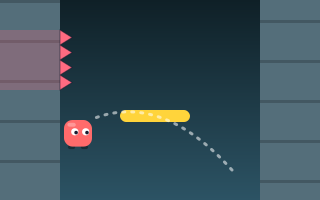
In Wall Jump, you cling to a wall and slide slowly down, pressing to leap to the opposite wall, while the screen scrolls upward. You have to avoid wall sections with spikes and floating bars between the walls. Sliding gives you a built-in way to wait, so you do not have to leap the instant you land. Use that slide to let a floating bar pass or to line up a jump past a spiked section, but keep an eye on the bottom of the screen: falling behind it ends the run.
Sky Jump: respect the wind
Sky Jump adds a jump button and a double jump to endless climbing across drifting cloud platforms. Periodic wind gusts push you sideways, with an on-screen WIND indicator showing the direction. Check the indicator before long jumps and save your second jump as a correction when a gust is active. Stars add bonus points to your height score, which leads to the next question: when to go for them.
Risk versus reward: when bonuses are worth it
Several endless games put bonuses off the safe path. The right choice depends on the phase you are in and on how the game scores you.
| Situation | Usually worth it? | Why |
|---|---|---|
| A star directly on your route in Sky Jump | Yes | Free points with no added risk |
| A star that needs a detour in the cruise phase | Often | The game is forgiving and you have room to recover |
| A star that needs your second jump in the survive phase | Rarely | A failed recovery ends the run and caps your score |
| A spring pad in Endless Jumper | Usually | Height is the score, and the pad gives height directly |
The general principle: in an endless game, surviving longer almost always adds more to your score than any single bonus. Take bonuses that are cheap, and skip ones that stake the whole run.
Pushing your personal best
Your best score for each game is saved in your browser, so you always have a target. A few habits help you beat it steadily:
- Set a near target. Aim to beat your best by a small margin rather than doubling it. Small gains compound.
- Play the early phase slowly. A careful cruise phase costs little time and removes cheap losses.
- Change one thing at a time. If you want to try using the wrap more in Endless Jumper, focus on only that for a few runs.
- Stop when your results dip. Several short runs in a row usually means focus has dropped. Come back later.
For how scoring systems and multipliers shape strategy, see how high-score jumping games work. If you notice the same failures recurring, common platforming mistakes lists the usual culprits.
Staying steady late in a run
The moment you realize you are close to your best is often when runs end. Attention shifts from the screen to the number, and jumps get rushed. Try to treat the survive phase exactly like the build phase: same eyes-ahead scanning, same one-jump-at-a-time focus. The record will follow from the jumps, not from thinking about it.
If you enjoy climbing specifically, vertical platform games explained looks at the upward-scrolling format in more detail. You can also browse the full endless jumping games category.
Key takeaways
- Endless games reward judgment over memorization, because layouts change every run.
- Most runs move through cruise, build and survive phases; match your risk level to each.
- Use each game's specific tools: the wrap in Endless Jumper, boosts in Bounce Up, the slide in Wall Jump and the double jump against wind in Sky Jump.
- Take cheap bonuses and skip ones that risk the whole run.
- Beat your best in small steps, and stay focused on jumps rather than the score late in a run.