Vertical Platform Games Explained
Vertical platform games turn the usual platformer on its side: instead of running left to right, you climb upward, and progress is measured by how high you get. That one change reshapes everything, from what the camera shows you to what counts as danger, because in a vertical game the threat usually comes from below, whether that is the bottom of the screen, a forced scroll, rising lava or a ticking clock. This guide explains how the format works, the different kinds of pressure it uses, and how to read a climb well.
Vertical versus horizontal: what actually changes
In a side-scrolling game, you see what is ahead of you by looking right, and gravity pulls you down toward the floor you are running along. In a vertical game, what is ahead is above you, and gravity pulls you away from your goal. Every jump works against the direction you want to go.
That creates a few consistent differences:
- Falling is progress lost. A missed jump in a side-scroller might mean landing a little further back. In a vertical game, it can mean dropping several platforms or off the screen entirely.
- Landings are from above. Platforms in climbers often let you pass up through them and only catch you when you come down on top.
- The screen is narrow and tall. Horizontal space is limited, so games add walls, wrapping or wind to make that space interesting.
- The camera usually only moves up. Once a platform scrolls off the bottom, it is gone.
Most vertical games on Jumping Arcade are also endless, which our endless jumping games guide covers from a pacing angle. Here the focus is on the vertical structure itself.
What chases you from below
Every vertical game needs a reason you cannot just wait on a safe platform forever. The pressure from below takes several forms, and recognizing which one you face changes how you should play.
| Pressure type | How it works | Game |
|---|---|---|
| Fall-off edge | The camera follows you up; falling below the screen ends the run | Endless Jumper, Sky Jump |
| Forced scroll | The screen moves up on its own and gradually speeds up | Tower Jumper, Wall Jump |
| Rising hazard | Lava rises from below and accelerates | Lava Jump |
| Timer | A fixed time limit; score is the height reached | Daily Jump Challenge |
| Sparser footholds | Pads grow further apart, so weak bounces stop being enough | Bounce Up |
Fall-off edge: your pace, your risk
When the camera only follows you, you control the pace. You can take a moment on a stable platform to plan. The danger is purely in missing jumps.
Forced scroll: the floor is moving
In Tower Jumper, the tower starts scrolling upward after the first floors and gradually speeds up. Standing still is no longer safe. You need a steady rate of climbing, and the game's momentum rule, where the faster you run the higher you jump, helps you keep up.
Rising hazard: a visible deadline
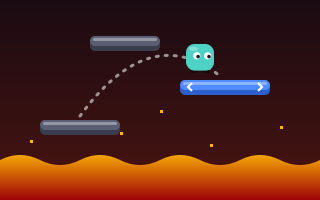
Lava Jump makes the pressure visible as lava climbing up the screen. Unlike a scroll edge, you can see exactly how much room you have. Use that information: when the lava is far below, take the safest route; when it is close, take the fastest.
Timer: race the clock
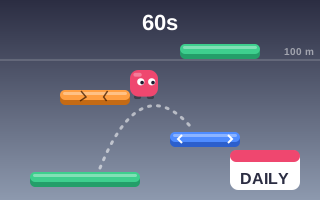
The Daily Jump Challenge gives you 60 seconds to climb as high as possible on a course generated from the date, so everyone playing that day gets the same layout. Nothing chases you physically, but every second spent hesitating is height you will not reach.
Making use of limited horizontal space
A tall, narrow play area means the left and right edges matter a lot. Vertical games handle those edges in different ways, and each turns them into a tool.
Screen wrap
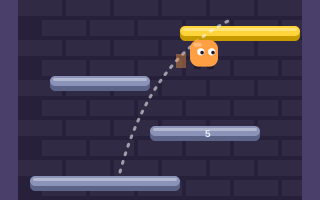
In Endless Jumper, leaving one side of the screen brings you back on the other. The edges stop being boundaries and become a shortcut, so the closest platform may actually be across the edge.
Solid walls you can use
Tower Jumper lets you bounce off the side walls, which lets you keep momentum instead of stopping when you reach an edge. Wall Jump goes further: the walls are where you spend most of your time, clinging and sliding before leaping across.
Sideways forces
Sky Jump adds wind gusts that push you sideways, shown by a WIND indicator. In a narrow space, a gust can move you a large fraction of the screen, so check it before committing to a long horizontal jump.
Reading a climb: look up, not at yourself
The most important vertical-game habit is keeping your eyes above your character. Since platforms appear from the top of the screen, anything you see there is information about your next few jumps.
- Find the next stable platform above you. That is your target, even if it takes two jumps to reach.
- Note any moving or one-use platforms between you and it, such as crumbling platforms in Endless Jumper or moving platforms in Lava Jump.
- Check your pressure. How close is the lava, the scroll edge or the timer?
- Pick a route that leaves you on something stable if possible, so you have a fallback.
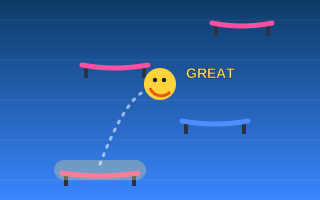
In Bounce Up, this reading is especially important because pads get sparser with height. Seeing the next pad early lets you steer the ball while it rises and time a boosted bounce when it lands.
Skipping platforms and combo climbing
Some vertical games reward covering more height in fewer jumps. Tower Jumper gives a combo bonus for jumping over several floors at once, and Bounce Up's chained boosts climb faster than ordinary bounces. Moving Platforms, a one-button climber, rewards centered landings with a bonus instead.
Skipping is powerful but risky. A multi-floor jump in Tower Jumper needs a lot of running speed, and a miss drops you back toward a scroll edge that is still speeding up. Build your combos in the early floors while the scroll is slow, and prioritize single safe floors when it catches up.
Why the vertical format stays popular
Vertical climbing suits short arcade sessions well. The goal is instantly clear, since up is good, and your progress is visible as a single number. It also fits naturally on a phone held upright. For practical technique on platforms of any orientation, read how to play platform jumping games, and for how climbing layouts are built, see how procedural platforms work. More climbing titles are listed under platform jumping games.
Key takeaways
- Vertical games put your goal above you and gravity against you, so missed jumps cost more.
- Pressure from below can be a fall-off edge, a forced scroll, rising lava, a timer or sparser footholds.
- Screen wrap, usable walls and wind make the narrow horizontal space part of the challenge.
- Read upward: find the next stable platform and plan the route to it.
- Build combos early while pressure is low, and switch to safe single jumps when it rises.