Endless Jumper
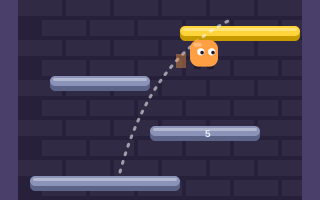
Bounce automatically, steer through wrap-around screen edges and climb past springs and crumbling ledges.
Daily Jump Challenge builds a new vertical course from each UTC date, so everyone who plays on the same day climbs the same layout. You get 60 seconds per run, a double jump, and as many retries as you want to raise your best height for the day.
Today's course (UTC): today. Everyone who plays today gets the same layout. There is no online leaderboard. Scores stay in your browser, and you can share yours with the Share Score button after a run.
Keyboard: ← → or A D to move · Space / ↑ / W to jump · P pause · R restart
| Action | Keyboard | Touch / mouse |
|---|---|---|
| Move left / right | ← → or A D | Hold the ◀ ▶ buttons |
| Jump | Space, ↑ or W | JUMP button or tap the game |
| Start / play again | Space or Enter | Start Game button |
| Pause / resume | P or Esc | Pause button above the game |
| Restart | R (after a run or while paused) | Restart button above the game |
The game pauses automatically if you switch tabs. Sound effects are generated in your browser and can be muted with the speaker button.
Every attempt today uses the same course, so each run teaches you something for the next one.
Climb as high as possible before the 60 seconds run out. Your score is the highest point you reached, in meters, and faint lines on the course mark every 50 meters.
The run ends when the timer hits zero or when you fall below the bottom of the screen, whichever comes first. Your best score for the current date is saved locally in your browser, and the course changes at 00:00 UTC. There are no online leaderboards: the Share button uses your device's share menu where available, or copies your result to the clipboard.
Difficulty: Difficulty: Medium
Daily Jump Challenge is rated Medium. The double jump and the chance to learn a fixed course make it more forgiving than an endless climber, but the 60-second limit rewards speed over caution. The course gets harder the higher it goes: over the first 350 platforms, gaps widen from about 70–105 units to 95–140, platforms narrow from 70–110 units to 50–80, moving platforms go from about 15% to 40% of the course, and crumbling ledges become slightly more common. How far into that ramp you get depends on how fast you climb.
Bounce automatically, steer through wrap-around screen edges and climb past springs and crumbling ledges.
Build running speed to launch over several floors at once, bounce off walls and stay ahead of the rising view.
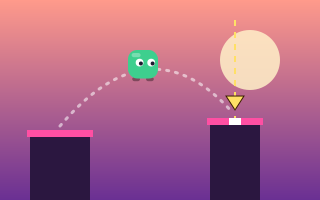
Press once as a sweeping marker crosses the next pillar, and chain center landings for up to 100 points each.
Yes. The course is generated from the current date in UTC, so every player gets the same layout on the same day. A new course starts at 00:00 UTC.
Your best score for each date is stored in your browser's local storage on this device, and it is never sent to a server. There are no online leaderboards.
It opens your device's share menu if your browser supports the Web Share API. Otherwise it copies a short result message with the game link to your clipboard.
Yes. The 60-second clock only runs while you're playing, so pausing with P, Esc or the pause button freezes it.
A breakdown of how arcade jumping games calculate your score, why multipliers matter so much, and how your best results are stored in your browser.
A plain-language look at how endless and daily jumping games build their platforms with code, from seeded random numbers to rules that keep every gap jumpable.
How vertical climbing games differ from side-scrollers, the kinds of pressure they use, and how to read and plan an upward climb.