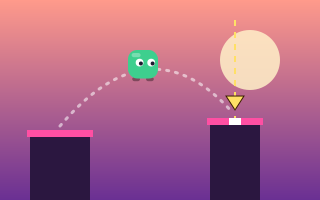
Precision Jumping Tips for Arcade Games
Precision jumping means landing on a specific spot, not just somewhere safe. The core of it is simple: pick your landing point before you jump, commit to one clean input, and make small corrections instead of large ones. The twelve tips below turn that into habits, grouped by the part of the jump they improve, with a game on Jumping Arcade where you can practice each one.
Before the jump: aim first
1. Choose a landing point, not a platform
"Get onto that platform" is a vague goal. "Land on its left third" is a precise one. Naming a spot changes how you steer, because you now have something to correct toward. It also leaves you room for error: aiming at the middle means a small miss still lands safely.
2. Look where you are going, not at your character
Your character's position is already known to you through the controls. Your eyes are better spent on the target and whatever comes after it. In vertical games, that means watching the area above your character where the next platforms are appearing.
3. Read two steps ahead
The best landing spot is often the one that sets up the following jump. In Spike Jumper, landing just past a static spike might put you directly in the path of a moving spike block. Plan the landing with the next hazard in mind.
Quick check: before each jump, silently answer two questions: where exactly will I land, and where will I go from there? If you cannot answer the second, slow down if the game lets you.
The input: one clean press
4. Commit to the input
Half-pressed or hesitant inputs produce jumps you did not plan. Once you have decided, press cleanly. This matters most in games where a single press sets everything, like Perfect Jump, where a power meter swings back and forth and your press locks in its current power. A hesitant press is simply a late press.
5. Treat press length as a control
In games with variable jump height, how long you hold is as important as when you press. Jump Over rewards a short tap to pass under hovering drones and a long hold to clear taller ground obstacles. Practice both until you can produce each on purpose.
6. Use the rhythm, not the reaction
When something moves in a regular pattern, like a swinging meter, timing by reaction is always a little late. Instead, count the rhythm of one or two swings and press on the beat. Because the Perfect Jump meter speeds up over time, re-find the rhythm every few pillars.
In the air: small corrections
7. Steer early and gently
A small correction at the start of a jump moves you as far as a big one near the end, and it is far easier to control. Late, sharp corrections are the main cause of overshooting. If your game allows mid-air steering, start adjusting as soon as you leave the ground.
8. Save your extra jump for corrections
In double jump games, the second jump is your precision tool. Using it straight away wastes it. Using it near the peak or on the way down lets you fix distance after you see where the first jump is heading. Our guide to double jump mechanics covers this in depth.
9. Account for outside forces
Some games push you around. In Sky Jump, periodic wind gusts push the player sideways, and an on-screen WIND indicator shows the direction. Aim upwind of your landing point and let the gust carry you onto it.
Moving targets: lead the platform
10. Jump to where the platform will be
A moving platform will not be where it is now when you arrive. Watch it pass once, notice where it will be when your jump lands, and press so you meet it there. In Moving Platforms, rows slide left and right above you and one press jumps straight up; you land only if a platform is under you, and centered landings give a bonus. Pressing slightly before the platform reaches you is usually right, because the jump takes time to rise.
11. Use the turnaround point
A platform that moves back and forth reverses at the ends of its path, and those end points never change while it keeps the same route. That makes them easier to predict than any point mid-slide. When in doubt, aim to land near where it turns around rather than while it is crossing the middle at full speed.
Contact timing: precision on landing
12. Time the moment of contact
Some games reward precision at the instant you land. In Bounce Up, the ball bounces automatically on trampoline pads, and pressing Jump just as it touches a pad gives a boosted bounce rated GOOD or GREAT. Chaining boosts climbs faster, which matters because pads get sparser with height. Watch the gap between the ball and the pad close, and press as it reaches zero instead of when the ball starts to fall.
Consistency beats heroic saves
Precision is less about pulling off impossible jumps and more about making ordinary jumps the same way every time. A player who lands every normal jump on the planned spot rarely needs a dramatic rescue. Three habits support that consistency:
- Same approach, same result. Whenever you can, take off from the same part of a platform. In games with momentum, such as Tower Jumper, where the faster you run the higher you jump, a consistent run-up gives a consistent arc.
- Reset between jumps. Release the direction key or lift your thumb briefly after landing. Carrying a held input into the next jump is a common source of drift.
- Accept a safe landing. If a jump goes slightly wrong, aim for any safe landing rather than trying to rescue the perfect one. A slightly worse position is almost always better than a failed run.
Keep an eye on how your misses change over time as well. Early on, misses tend to be large and random. As precision improves, they become small and consistent, such as always landing a little long. A consistent miss is good news: it means you only need to adjust one thing, like pressing a touch earlier or steering a touch less.
Three drills to lock it in
- Center-only run. Play a run of Moving Platforms where you only care about centered landings, even if it ends early. It trains aim over survival.
- Rhythm run. In Perfect Jump, say "and-now" in time with the meter and press on "now." Stop counting once it feels automatic.
- Checkpoint loop. In Spike Jumper you have 3 lives and respawn at the last checkpoint, so you can deliberately repeat one tricky section and try a different landing point each time.
Still missing more than you expect? Our list of common platforming mistakes may name the habit, and how to improve jump timing goes deeper on the timing side. For more games that reward exact landings, browse platform jumping games.
Key takeaways
- Pick an exact landing spot before every jump, with the next jump in mind.
- Make one committed input; treat press length as part of the aim in variable-height games.
- Correct early and gently in the air, and hold extra jumps back for fixes.
- Lead moving platforms and favor the moment they turn around.
- Where contact timing is rewarded, press as the gap closes, not before.