Double Jump Mechanics Explained
A double jump lets you jump a second time while already in the air, and the key to using it well is treating that second jump as a limited resource you spend on purpose rather than a reflex. When you press it changes the outcome: an early second jump mostly adds distance, a late one adds height and hang time, and a saved one gives you a safety net. This guide explains how the mechanic works, the four main reasons to use it, and how it plays out in the double jump games on Jumping Arcade.
How a double jump works
In a normal jump, once you leave the ground your path is mostly set. You rise, slow down, reach the top of the arc and fall. A double jump breaks that rule once per airtime: pressing jump again in mid-air starts a fresh upward push from wherever you currently are.
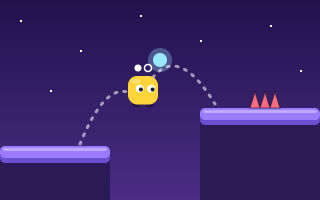
In most games with this mechanic, you have two jumps available while grounded and landing restores them. Double Jump Challenge makes this visible with two dots that show how many jumps you have left. Watching those dots is a quick way to learn the mechanic, because you can see exactly when you have spent your second jump and when it comes back.
The important consequence is that you cannot double jump twice. If you spend your second jump and still need more height, there is nothing left. That is why the decision about when to use it matters so much.
Timing the second press
Because the second jump starts a new push from your current position, the moment you press it shapes the whole arc. It helps to think of three windows.
| When you press | What tends to happen | Good for |
|---|---|---|
| Early, while still rising | A long, flatter combined arc | Crossing a wide gap quickly |
| Near the top of the first jump | The highest total point you can reach | Reaching a much higher platform |
| Late, while falling | Arrests the fall and buys time | Rescuing a jump that is going short |
These are general tendencies rather than exact rules, since each game tunes its own jump physics. The best way to learn a specific game is to try all three windows on a safe stretch and watch where you end up. Our guide to jumping game physics explains why the arc behaves this way.
The four reasons to use a double jump
1. Distance
The simplest use: a gap is too wide for one jump. In Double Jump Challenge, the auto-scrolling runner crosses floating platforms at different heights with gaps between them. For a wide gap at similar height, jump near the edge and add your second jump while still rising to carry you across.
2. Height
When the next platform is well above you, save the second jump for the top of your first arc. In Sky Jump, where clouds drift horizontally at different heights, this is often the only way to reach a higher cloud.
3. Correction
Sometimes a jump goes wrong: you misjudged the distance, a platform moved, or something pushed you. A saved second jump lets you fix it. Sky Jump's periodic wind gusts, shown by the on-screen WIND indicator, can shove you sideways mid-flight. Keeping your second jump in reserve during a gust gives you a way to recover.
4. Delay
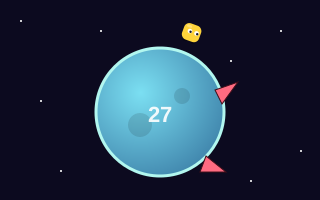
A double jump can also buy time. If you are about to land on a spike or into a hazard's path, a late second jump keeps you in the air a little longer. In Tiny Jumper, where spikes appear on the surface of a small round planet you circle, a second tap can stretch your airtime to clear a spike you jumped for slightly too early.
Spend or save: making the decision
The hardest part of the mechanic is not executing it but deciding whether to use it now. A simple rule of thumb: spend it when the current jump clearly needs it, save it when you are not sure.
- If you can see that one jump reaches the target, do not press again. Your second jump stays available as insurance until you land.
- If you can see that one jump falls short, commit to the second jump at the right window instead of hoping.
- If you cannot tell yet, wait. Pressing early "just in case" leaves you with nothing if the situation gets worse.
Spikes change this calculation. In Double Jump Challenge, some platforms carry spikes, so landing spots are limited. You may need to use your second jump to pass over a spiked platform to a safe one, which means planning the whole jump before takeoff rather than improvising mid-air.
Double jumping under pressure
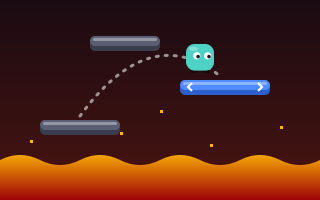
Lava Jump shows what happens when the double jump meets a time limit. You climb upward while lava rises and gradually accelerates, and some platforms move. Here the second jump becomes a speed tool as much as a safety tool. Using it for height lets you skip a platform and gain distance on the lava.
That creates a real trade-off. Spending the second jump for height moves you up faster, but leaves you without a correction if you land badly or a moving platform shifts. When the lava is far below, play it safer and keep the second jump as insurance. When it is close, use it to climb.
Speed increases in Double Jump Challenge create a similar squeeze. As the runner accelerates, gaps arrive faster, and the window for choosing when to press the second jump shrinks. Practicing the three press windows early in a run, when there is time to think, helps them become automatic later.
Common double jump mistakes
- Double-tapping by habit. Both jumps fire before you know whether you need the second.
- Using it too late. Once you are far into a fall, one more jump may not be enough to reach the target.
- Forgetting it exists. In games where it is optional, players sometimes fall short with a second jump still unused. Glance at indicators like Double Jump Challenge's dots.
- Chasing bonuses with it. Floating orbs in Double Jump Challenge and stars in Sky Jump add points, but spending your second jump on a detour can leave you stranded.
For more on aiming your landings once you are in the air, see precision jumping tips, or explore more titles in the double jump games category.
Key takeaways
- A double jump is one extra mid-air push per airtime; in most games landing restores it.
- Pressing early adds distance, near the top adds height, and late while falling buys time.
- Use it for distance, height, correction or delay, and know which one you need before pressing.
- When unsure, save it: an unused second jump is insurance until you land.
- Under pressure, as in Lava Jump, weigh the height it gives you against the safety net it provides.