How Platform Jumping Games Work
Platform jumping games work by running a loop many times per second that reads your input, applies gravity and movement to your character, checks whether you have landed on or hit anything, moves the camera and draws the result. On top of that loop sit a handful of rules: which surfaces you can stand on, how each platform type behaves, how the screen scrolls, and how difficulty and score increase. This guide explains each of those systems in plain terms, so you can see why a jump succeeds or fails.
The game loop: a flipbook that listens
A browser game does not move smoothly the way a video does. It redraws the screen over and over, each time with everything shifted slightly. Browsers provide a function called requestAnimationFrame that lets a game schedule its next update in step with the display's refresh, which is how many HTML5 games, including the ones on Jumping Arcade, keep motion smooth.
Each pass through the loop, or frame, typically does the same things in order:
- Read input. Is a direction or jump key held? Was the screen tapped?
- Update movement. Apply gravity, speed and any forces to the character and moving objects.
- Check collisions. Did the character land on a platform, touch a hazard or fall off the screen?
- Update the camera and score. Scroll the view and record progress.
- Draw. Paint the new frame onto the canvas.
Because this happens in small steps, your input only takes effect on the next frame. That is why a press that feels "just in time" sometimes arrives a fraction too late.
Gravity and the shape of a jump
A jump in a platform game is usually two numbers working against each other: an upward speed given at takeoff and a downward pull that reduces it every frame. The character rises quickly, slows, pauses at the top and falls faster and faster. The result is the familiar curved arc.
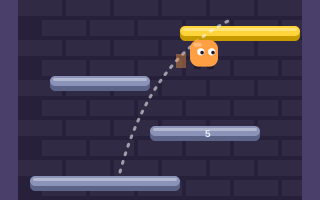
Horizontal movement is handled separately. If you hold a direction, the game adds sideways speed, which is why you can steer in mid-air in games like Spike Jumper. Some games link the two. In Tower Jumper, the faster you run, the higher you jump, so horizontal speed feeds into the takeoff.
The details of arcs, speed and variable jump height are covered in depth in jumping game physics explained. For this overview, the key idea is that your jump is predictable. The same takeoff in the same conditions gives the same arc, which is what makes practice pay off.
Landing: how the game decides you are standing
Collision checks are the heart of a platform game. Every frame, the game asks whether the character's shape overlaps something, and if so, what should happen.
Landing from above
In many jumping games, especially vertical climbers, platforms only count when you land on them from above while falling. You can pass up through a platform from below and then land on its top. This is often called a one-way platform, and it is what allows the constant upward bouncing in Endless Jumper.
Land or miss
Some games make landing a simple yes-or-no check at the moment of arrival. In Moving Platforms, you jump straight up to the next row and land if a platform is under you. The game also measures how centered you are and awards a bonus for centered landings.
Hazard contact
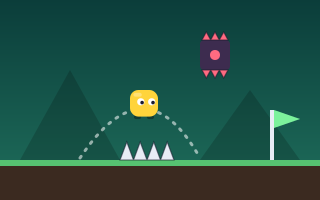
Hazards use the same overlap check but trigger a different result: losing a life, ending the run or respawning. In Spike Jumper, touching static spikes or moving spike blocks costs a life, and you respawn at the last checkpoint flag.
Platform behaviors as simple rules
Different platform types are usually the same basic object with one extra rule attached. Seeing them this way makes them easier to read.
| Rule added | Example | Effect on you |
|---|---|---|
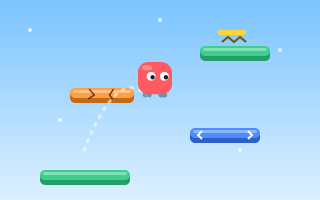
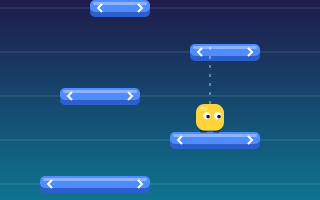
| Moves sideways each frame | Blue platforms in Endless Jumper, drifting clouds in Sky Jump | You aim at a future position |
| Breaks after one use | Orange crumbling platforms in Endless Jumper | You get exactly one bounce |
| Launches you harder | Yellow spring pads in Endless Jumper, trampoline pads in Bounce Up | You gain extra height |
| Carries a hazard | Spiked platforms in Double Jump Challenge | Only part of the platform, or none of it, is safe |
When you meet a new platform type in any game, ask which single rule it adds. That usually tells you how to treat it.
The camera and scrolling
The camera decides what part of the world you can see, and in jumping games it often doubles as a hazard.
- Following camera. The view moves up as you climb, and falling below the bottom edge ends the run. Endless Jumper works this way.
- Forced scrolling. The screen moves on its own regardless of what you do. Tower Jumper starts scrolling upward after the first floors and gradually speeds up; Wall Jump scrolls upward too, and falling behind the bottom ends the run.
- Side scrolling. The world moves horizontally past you, as in Spike Jumper's generated sections.
Screen wrapping is another camera rule. In Endless Jumper, leaving one side of the screen brings you back on the other, which effectively removes the side walls and gives you a shortcut across.
Difficulty that rises by itself
Arcade platform games rarely have hand-built levels that end. Instead, they place platforms and hazards as you go, following rules that get stricter over time. In Endless Jumper, gaps widen and special platforms become more common as you climb. In Moving Platforms, platforms speed up and shrink.
This is why each run feels familiar but not identical. The rules are fixed, but the specific layout changes. The Daily Jump Challenge is a deliberate exception: it generates its course from the date, so every player sees the same layout on the same day. For how layouts are generated, read how procedural platforms work.
Scoring: turning movement into a number
Finally, the game converts your progress into a score. Common approaches include height climbed (Endless Jumper), floors reached (Tower Jumper), distance (Spike Jumper, with checkpoint bonuses) and rows climbed plus bonuses (Moving Platforms). Your best result is saved in your browser's local storage, which is why it is still there next time you visit on the same device.
Understanding what the score measures helps you decide what to prioritize. If the score is height, detours for bonuses only make sense when they are nearly free. More on this in our guide to arcade jumping game design basics, and you can browse all platform jumping games to see these systems in action.
Key takeaways
- A game loop reads input, updates movement, checks collisions, moves the camera and draws, many times per second.
- Jumps follow predictable arcs created by an upward push and a constant downward pull.
- Many platforms only catch you when you land on them from above while falling.
- Each platform type is usually a normal platform with one extra rule, such as moving or crumbling.
- Scrolling cameras and rising difficulty rules keep pressure on without hand-built levels.