Beginner's Guide to Jumping Games
If you are new to jumping games, start with a game that uses one button or only left and right steering, play short runs, and focus on one skill at a time. Jumping arcade games are quick to learn because every run starts easy and gets harder gradually, and nothing carries over between runs except your best score. This guide explains what the games ask of you, which of our games to try first, the terms you will see, and how to build from easy to hard without frustration.
What you actually do in a jumping game
Nearly every jumping game combines three jobs:
- Timing: deciding when to jump.
- Aiming: deciding where you will land, by steering, choosing jump strength or picking the right moment.
- Reading: noticing what is coming, such as gaps, hazards or moving platforms.
Beginner-friendly games remove one or two of these jobs so you can learn the rest. A game where your character bounces automatically removes timing. A game with one button and no steering removes aiming by direction. That is why the right first game makes such a difference. For a wider introduction to the genre itself, see what are jumping arcade games.
Five easy games to try first
These games are rated Easy on Jumping Arcade. Each teaches a different core skill:
| Game | Controls | What it teaches |
|---|---|---|
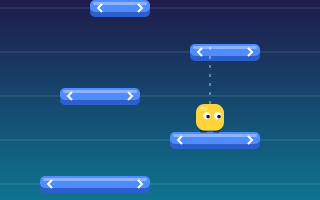
| Endless Jumper | Left/Right only | Steering and reading platforms |
| Perfect Jump | One button | Timing a single press |
| Jump Over | One button, tap or hold | Jump height and obstacle spacing |
| Moving Platforms | One button | Leading a moving target |
| Bounce Up | Left/Right plus Jump | Steering with an optional timing bonus |
Start here: Endless Jumper
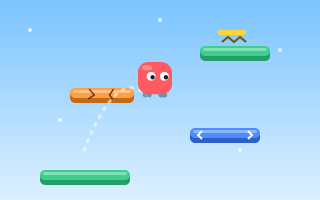
Endless Jumper is the gentlest start. Your character bounces by itself, so all you do is steer left and right. Going off one side of the screen wraps you to the other, which is handy once you notice it. You climb by landing on platforms, and the color tells you what each does: green is normal, blue moves sideways, orange crumbles after one bounce, and yellow spring pads launch you higher.
Then try a one-button game
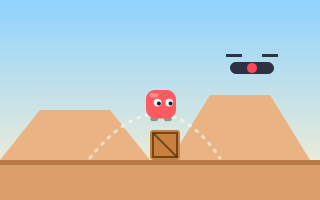
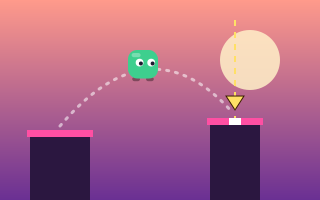
Perfect Jump strips things down to a single decision. A power meter swings back and forth; press to jump with the current power and land on the next pillar. Once that feels comfortable, Jump Over adds a second idea: a tap makes a short hop and a hold makes a higher jump, which matters because some hovering drones can only be passed with a short hop underneath.
Beginner tip: keep your first runs short and low-pressure. Losing quickly in the first minutes is normal, and each quick restart shows you the opening again, which is exactly the part you need to learn first.
Controls in one minute
On a computer, steering uses the arrow keys or A and D, and jumping usually uses Space, Up or W, depending on the game. One-button games use a single key such as Space, or a click. On a phone, you tap the screen, tap its left or right half to steer, or use on-screen buttons. Each game page lists its exact controls. For the full picture, read jumping game controls explained, or mobile jumping game controls if you play on a phone.
Terms you will see
- Run: one attempt from start until it ends.
- Personal best: your highest score in a game, saved in your browser on your device.
- Double jump: a second jump made in mid-air, available in some games.
- Combo or multiplier: a bonus that grows when you do something well several times in a row, such as PERFECT landings in Perfect Jump.
- Auto-runner: a game where your character moves forward by itself and you only jump.
- Checkpoint: a saved position you return to after a mistake, as in Spike Jumper.
How runs end (and why that is fine)
Jumping arcade games are designed so that every run ends eventually. That can feel discouraging at first, but it is the whole structure of the genre: each run is short, and the goal is to go a little further than last time. Knowing what ends a run in each game helps you focus on the right thing:
- Falling: in Endless Jumper and Sky Jump, falling below or off the bottom of the screen ends the run. Watch the platforms above you and steer toward them early.
- Missing a landing: in Perfect Jump, missing the next pillar ends the run, so a safe landing always beats a risky attempt at the center target.
- Hitting an obstacle: in Jump Over, the auto-running character must clear ground obstacles and hovering drones as speed increases.
- Running out of time: Daily Jump Challenge gives you 60 seconds to climb as high as you can on a course that is the same for everyone that day.
When a run ends, take a second to notice why before you restart. That habit alone speeds up learning more than playing many runs without thinking about them.
A plan for your first sessions
- Session one: ten or so runs of Endless Jumper. Aim only to get used to steering and to recognize the four platform colors.
- Session two: Perfect Jump and Jump Over. Pay attention to how your press timing changes the result.
- Session three: Moving Platforms. Rows of platforms slide left and right above you, and one press jumps straight up. Practice pressing a moment before a platform arrives under the spot you will reach.
- After that: pick a Medium game that adds one new idea, such as Sky Jump for double jumping or Wall Jump for alternating walls.
Try not to compare your early scores with anything but your own previous runs. The game saves your personal best, so improvement is easy to see over time.
When to move up a difficulty
A good sign that you are ready for harder games is when your runs in an Easy game end because the game got fast, not because of early mistakes. At that point, the Medium and Hard games will stretch you rather than overwhelm you. Hard games on the site, like Tower Jumper, Lava Jump, Spike Jumper and Jump Rush, add pressure such as a scrolling screen, rising lava or one-hit failure, so tackle them once the basics feel automatic.
You can see every game with its difficulty on the all games page, or start with a category such as one-button jump games.
If you get stuck
Everyone hits a plateau. When your score stops improving, the cause is usually a single habit, such as jumping too early or using a double jump straight away. Our list of common platforming mistakes helps you spot it. You can also switch games for a while: a different game often practices the same skill from a new angle.
Key takeaways
- Jumping games combine timing, aiming and reading what comes next.
- Start with Endless Jumper for steering, then Perfect Jump and Jump Over for timing.
- Keep early runs short and relaxed; learning the opening is the first goal.
- Compare scores only with your own personal best, which is saved in your browser.
- Move to Medium and Hard games once your runs end because of speed, not early slips.
Explore more articles in the guides hub.